
Oklahoma State Question 832
A Tough Test for the Minimum Wage on the Ballot

Tomorrow, Oklahomans will vote on State Question 832, which would raise the state’s minimum wage from $7.25, the federal floor that has been stagnant since 2009, to $12 in 2027, $13.50 in 2028, and $15 in 2029, after which it would be indexed to the cost of living. Currently, 30 states have minimums exceeding the federal floor, including 12 states that voted for the Republican candidate in the 2024 presidential election. But 20 states do not, and that includes Oklahoma.
I’ll be watching the returns closely.
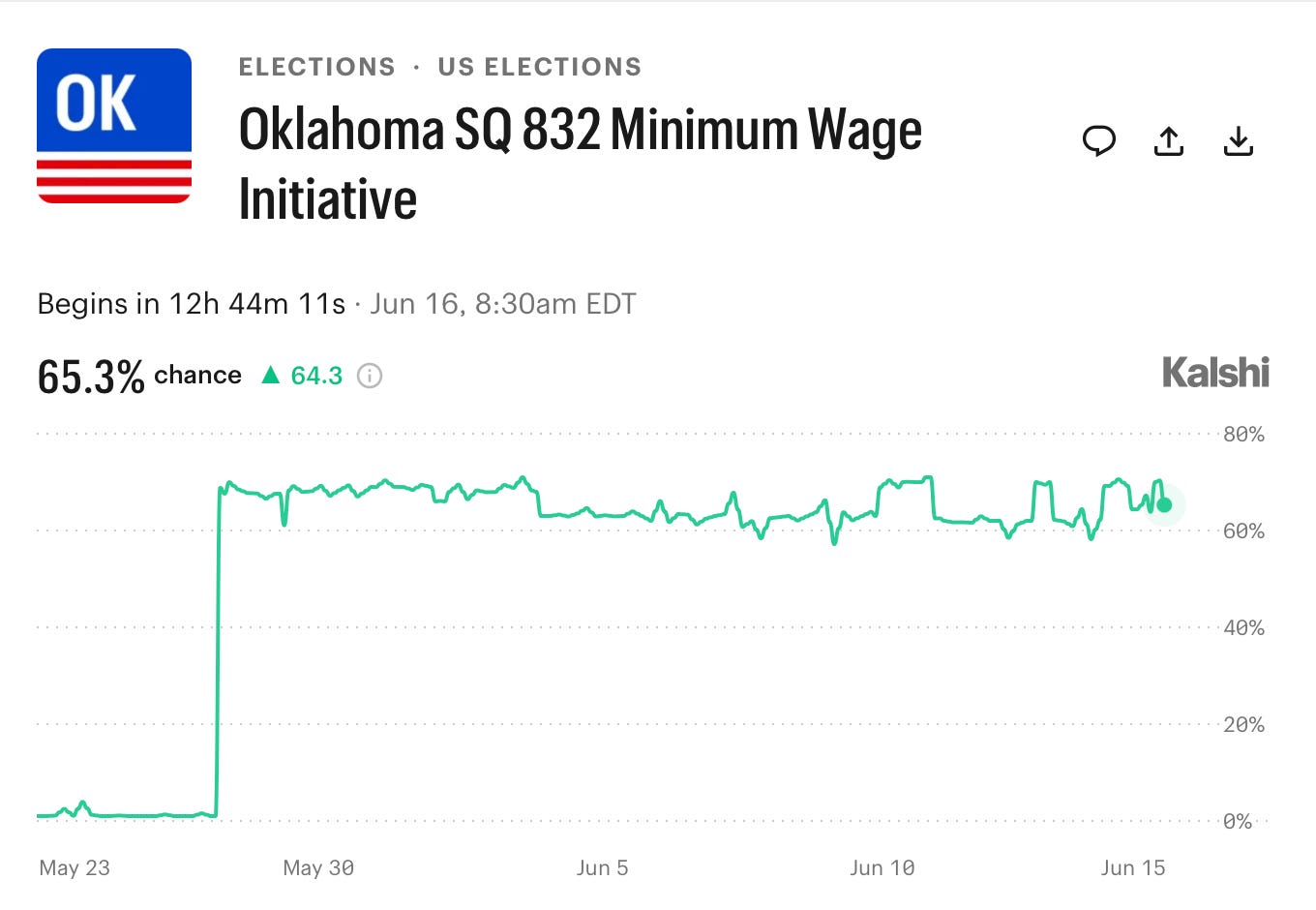
The prediction market, Kalshi, suggests that SQ 832 has about a 65% chance of passing. That suggests a slight edge, but hardly a sure thing. Rather, it points to a competitive, uncertain race. And however it lands, the results will be of interest to the country at large.
Let me explain why this is a particularly tough test, and what we know about the evidence of what minimum wage hikes would do in states like Oklahoma.
This is a tough test
Two facts make tomorrow’s vote particularly interesting. First, it turns out that most minimum-wage ballot initiatives pass. Over the past three decades, general minimum wage increase was rejected at the ballot box only once.1 Ballot initiatives to raise the minimum wage have passed in Red and Purple states including Nebraska, Florida, Missouri, Alaska, and Arizona.
However, local circumstances make this Oklahoma election a bit different. Unlike past races, SQ 832 shares the ballot with party primaries, and in this cycle the contested races are largely on the Republican side. So the people who turn out to vote will likely lean heavily GOP, in a state that is already strongly Republican. That makes tomorrow’s vote a particularly tough test of how popular the minimum wage is with Republican voters specifically, with little help from Democratic turnout.
What does the evidence say?
So what do minimum wage policies actually do? And are most voters (who tend to support raising the minimum wage) making sound decisions? Or are they harming the very people they’re trying to help, like by killing jobs?
We have a terrible way of setting minimum wages in this country. In 30 states, we have state-wide minimums (like the type Oklahoma will be deciding on). In the other 20 states, we have a federal floor of $7.25, which hasn’t been adjusted since 2009, and is so low that might as well be zero. (It would make little difference it it were zero.). Ironically, however, this dysfunctional system creates a “natural experiment” of sorts that helps us understand the causal effects of minimum wage policies.
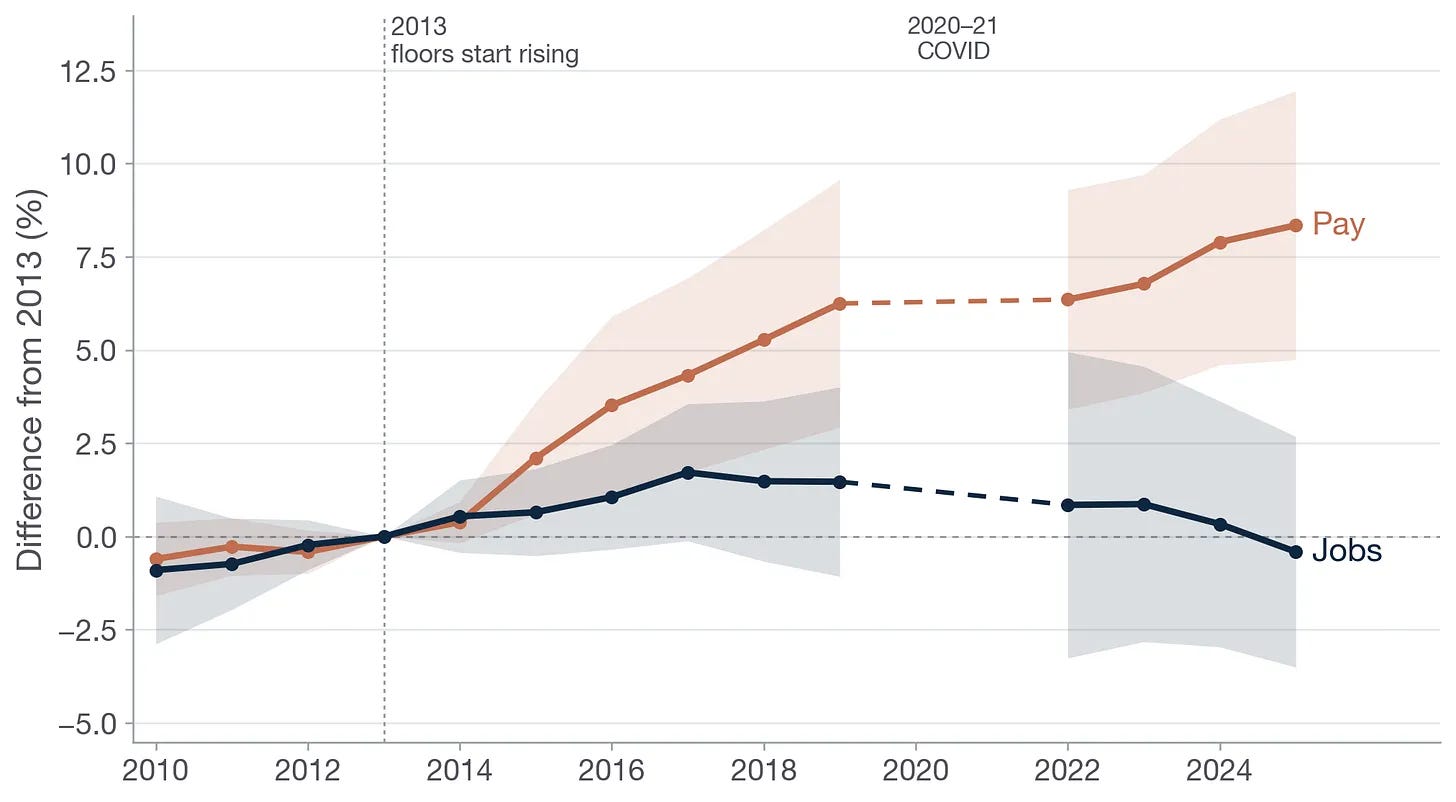
What does this experiment show? Payroll data, covering nearly every private sector employer provides very clear evidence that the policy raised pay in low-wage sectors (like restaurants). However, the evidence suggests minimal impact on jobs.
Figure: Year-by-year restaurant pay and jobs gap: raise states minus federal-floor states
On the ground
I was in Oklahoma just this past week, talking about the evidence with voters and press there. I take this race seriously, and wanted to make sure I could contribute in my very limited way by providing data on this important question.
For more, on this check out my op-ed here, and this piece as well.
At the end of the day, I see this vote going either way. But in any case, it will be an important lesson for America, as we try to rebuild the wages for working and middle class people in this country.
If this interests you, check out my book, The Wage Standard.
That lone case was California Proposition 32 in 2024. However, Prop 32 was a highly unusual case: a lone funder, Joe Sanberg, spent around $10M to qualify it for the ballot. But it didn't garner any support from usual backers like labor unions, and Sanberg didn't spend money in the actual election campaign. As a result, the pro-side was largely silent — and yet it lost by less than 2 points.